There is a lot of noise in the dog training world right now.
On one side, the force-free community argues that we should avoid pressure and aversives entirely, relying instead on positive reinforcement to shape behavior. On the other, balanced trainers argue that fair corrections, used sparingly and skillfully, are sometimes necessary for clarity.
Before taking sides, let’s be intellectually honest.
At its best, force-free training produces thoughtful, motivated dogs who work with their handlers because they want to, not because they feel compelled. Skilled force-free trainers excel at building engagement, shaping complex behaviors, and teaching dogs how to succeed without fear or confusion. For the vast majority of companion dogs—and for many working dogs in foundational training—positive reinforcement builds confidence, creativity, and a strong emotional bond.
It has also pushed our entire industry away from outdated, heavy-handed methods that relied more on intimidation than understanding. That course correction was necessary. I use these principles every single day.
But problems arise when a useful framework turns into an absolute ideology.
When the Model Stops Matching the Dog
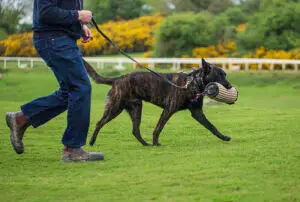
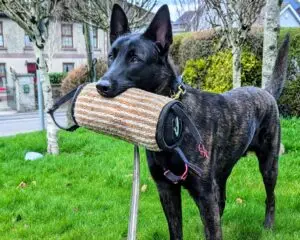
Things get particularly heated when we talk about high-drive working breeds—the Malinois, the Dutch Shepherds, the working-line GSDs.
When asked how to control a high-octane police or sport dog under real-world pressure using only positive reinforcement, some force-free absolutists will quietly admit that it isn’t always possible. But rather than questioning the limitations of their methodology, the narrative twists.
As per Roman Gottfried’s recent commentary, the argument shifts to claiming that these dogs are “genetically broken,” “too extreme,” or breeding failures simply because they require aversives to function safely.
I find that to be an impressive feat of mental gymnastics.
That conclusion says more about the limits of the model than the nature of the dog. High-drive working dogs aren’t broken. They are exactly what we bred them to be. In many ways, they are closer to the original canine blueprint—the wolf—than the average pet dog. Biology doesn’t care about our ideals.
These dogs are the Ferraris of the dog world, and you cannot drive a Ferrari at 200 mph the same way you drive a minivan.
Different machines require different inputs.
The Anthropomorphism Trap
One of the biggest obstacles to honest discussion is our tendency to humanize dogs.
A common refrain is: “If you wouldn’t do it to your child, don’t do it to your dog.”
But this comparison breaks down quickly. Humans share a complex spoken language. We can explain abstract concepts, delayed consequences, and future outcomes to children. Dogs live almost entirely in the present. In the canine world, boundaries are immediate and physical. Dogs don’t withhold rewards to make a philosophical point—they apply pressure clearly and release it just as clearly.
Still, for the sake of argument, let’s humanize the dog for a moment.
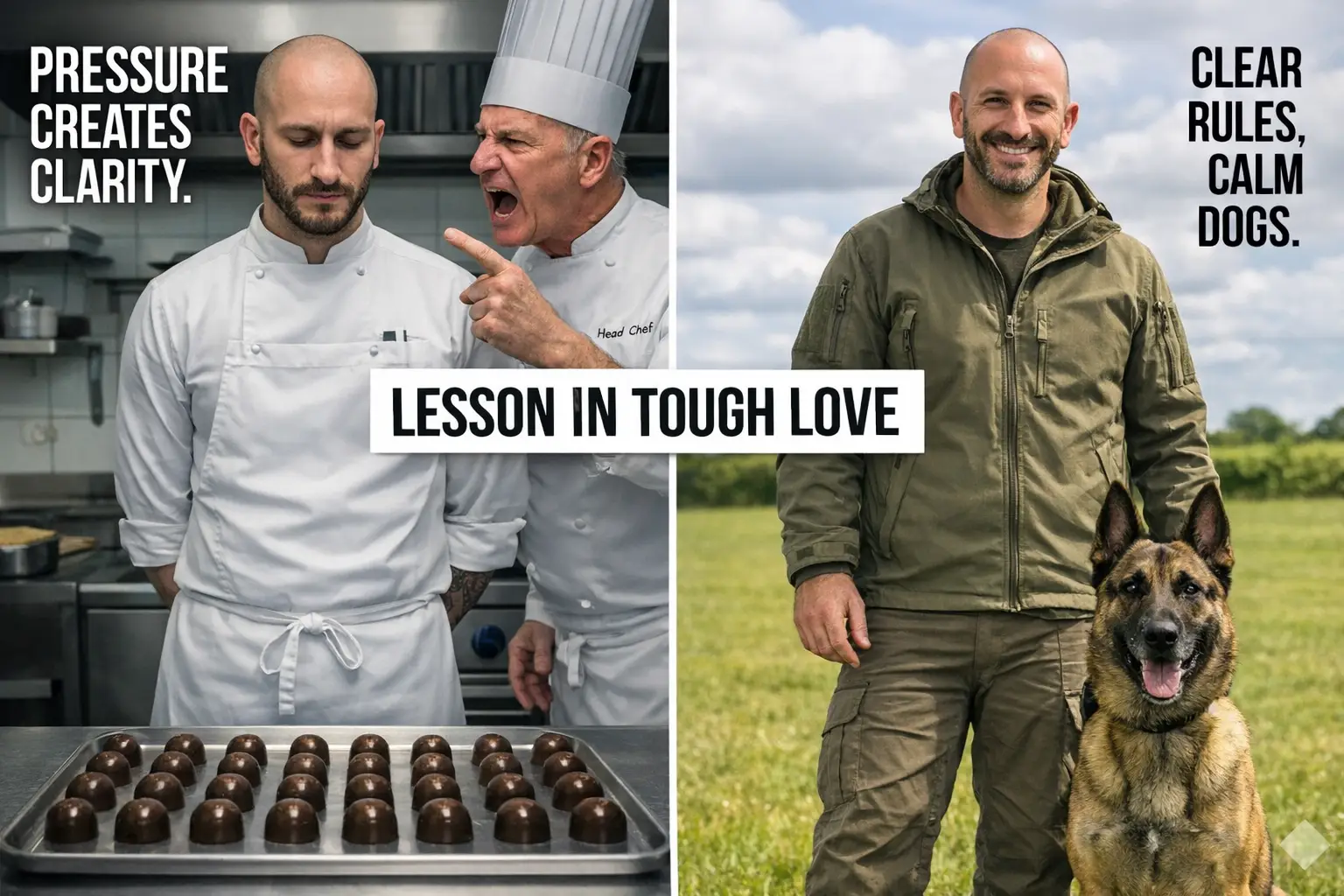
A Lesson in Tough Love
In the early 2010s, I landed a trial as Head Chocolatier at one of London’s most anticipated hotel openings. I travelled from Belgium full of confidence and pride in my craft.
At the end of my shift, the Executive Pastry Chef looked at my work and asked a simple question: “Was this your best?”
I tried to justify it. I blamed the time constraints. He replied, “Good. Because if this was your best, there’s no chance I’d hire you.”
I was hired—but for a while, I worked like I was on thin ice. I was afraid to make mistakes. That fear wasn’t paralyzing; it was clarifying. It forced me to pay attention, absorb everything he taught me, and rise to a standard I hadn’t fully grasped before.
Now imagine if he had taken a purely force-free approach to mentorship—avoiding uncomfortable feedback, ignoring mistakes, hoping I’d eventually stumble into excellence.
I wouldn’t have learned a thing. I would have stayed confused, frustrated, and stagnant.
Because he applied pressure—fairly and purposefully—he laid the foundation for my entire career. I owe my success to someone who cared enough to hold me to a standard.
Pressure Creates Clarity
I see the same principle in dogs.
I live with a rescue shepherd mix: high energy, low food drive, no toy drive, and no sense of boundaries. He wasn’t aggressive or “bad”—but he was chaotic. Every cue was a negotiation. He never switched off. He was a sports car with no steering wheel, and it was exhausting for both of us.
Treats didn’t motivate him. Play didn’t anchor him. More freedom just created more noise.
So I introduced negative reinforcement—not to punish, but to communicate. Clear, low-level pressure paired with immediate release. A simple message: This isn’t optional.
The result wasn’t fear. It was relief.
Once “No” actually meant “No,” he exhaled. The constant testing stopped. The anxiety of guessing the rules disappeared. He became calmer, more predictable, and ultimately a better companion.
About Tools, Sensation, and Reality
Much of the outrage around tools, especially e-collars, rests on misunderstanding.
Modern e-collars aren’t binary “shock devices.” A Dogtra unit ranges from 0 to 127. I typically work between 6 and 12. At those levels, the sensation is less intrusive than poorly applied leash pressure and far less intense than what dogs routinely experience during play, especially working dogs.
Sensation alone does not cause trauma. Confusion, unpredictability, and lack of control do.
When pressure is clear, fair, and escapable, it can reduce stress rather than create it.
Conclusion
We can’t explain standards to dogs with words. We can’t solve every problem with food. And pretending otherwise doesn’t make us kinder it often makes dogs more anxious.
Holding a dog to a clear, fair standard doesn’t damage the relationship. When 95% of your interactions are playful, enriching, and affectionate, that remaining 5% of firm boundary-setting doesn’t erode trust, it strengthens it.
My chef didn’t ruin me by demanding excellence. And you won’t ruin your dog by demanding obedience.
For some dogs, in some contexts, clarity isn’t optional. It’s compassionate.